Creative: Write an imaginary conversation you are having either with one of the artists that you looked at yesterday or one of the characters that you saw in one of the paintings.
The English Channel-2015
Michael Parekowhai
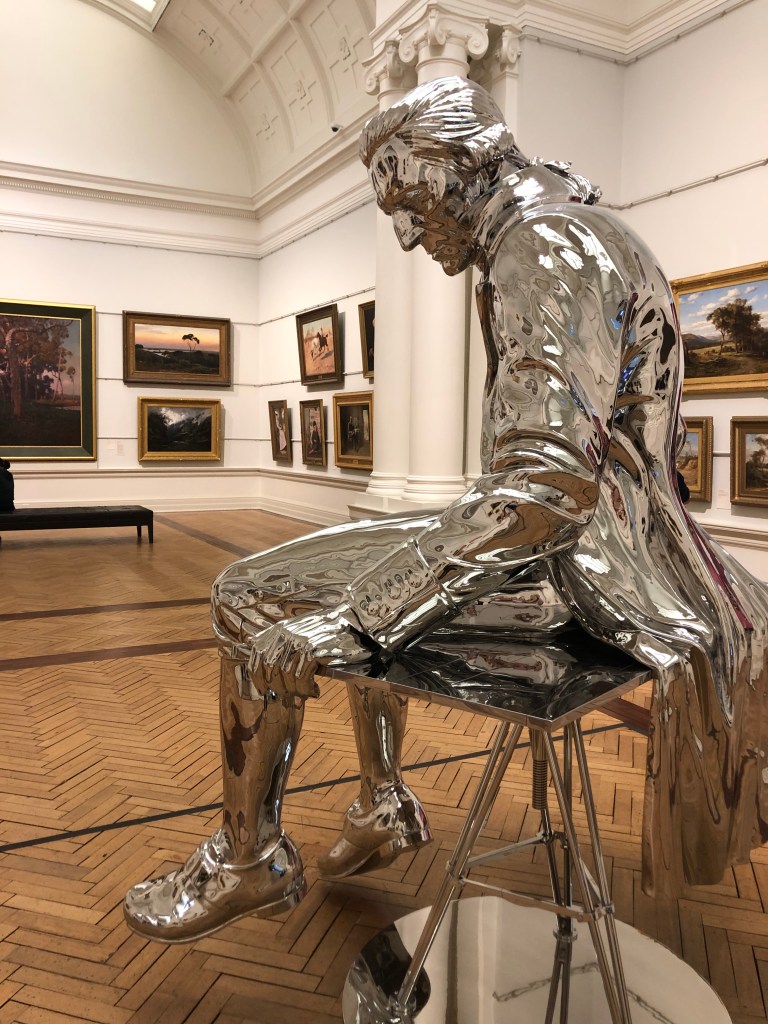
Photo by Emily Baker 26.8.19
Dear Mr Cook,
I just have one question; are you proud?
Sitting here amongst these paintings, all inspired by a world you took so little time to understand, before you planted your flag and sailed on to your next conquest. Your usually triumphant look appearing crumpled despite your shiny exterior. Do you realise what you’ve done? Did you think about the consequence of your colonisation quest? Or was money and accolade all that lay before you?
Do you understand the destruction of both land and animal your discovery caused? Did you ever see its grace or beauty, this ancient raw land or was it just another uncultured place needing to be claimed and tamed? Did you not see they were one with it all? How could you have been so arrogant to think it was yours for the taking?
Did you see them there? Where was your respect for a people far more rich in culture, tradition, and spirituality than anything you had ever known? Oh all the things you could have learnt from them.
Was there no price to high for the expansion of your empire? The lives you’ve left murdered in cold blood; The babes ripped from mothers’ arms; The rape, abuse, torture and death you have left in your wake; the transgrenerational pain and displacement. Is this the legacy you intended?
Because from where Im standing, your slumped, defeated, shamed appearance seems rather fitting.
Yours Sincerely
A mother of children who are inheriting the mess you left behind


 Em's Literature Blog
An incredibly poignant piece Emily. The listing of those questions makes for an inordinately heavy burden; powerful, heartfelt expression.
I was quite tempted to compose an answer to that question with that very same artwork before I decided on something else. Coincidentally the history unit I am currently doing just had an entire week based upon him so I wanted possibly contribute some of the insights I’ve gleaned.
As the first European to sail and chart the eastern coast of Australia Cook was originally instructed to travel to Tahiti to observe the passing of Venus, with sealed orders to open upon arrival, which instructed him to afterwards chart the eastern coast of Terra Australis, the great unknown southern land. Among his secret instructions was the following passages:
“You are likewise to observe the Genius, Temper, Disposition and Number of the Natives, if there be any and endeavour by all proper means to cultivate a Friendship and Alliance with them, making them presents of such Trifles as they may Value inviting them to Traffick, and Shewing them every kind of Civility and Regard…
You are also with the Consent of the Natives to take Possession of Convenient Situations in the Country in the Name of the King of Great Britain: Or: if you find the Country uninhabited take Possession for his Majesty by setting up Proper Marks and Inscriptions, as first discoverers and possessors”
Whilst imperialistic, it doesn’t read as overtly hostile. Australia was not initially viewed as a great verdant land of untapped riches, England wanted a penal colony in the wake of the loss of the Americas and the fear stemming from the French Revolution. Cook’s journal after this journey gives some great insights:
“From what I have said of the Natives of New Holland they may appear to some to be the most wretched people upon earth, but in reality they are far more happier than we Europeans; being wholy unacquainted not only with the superfluous but the necessary conveniences so much sought after in Europe, they are happy in not knowing the use of them. They live in a Tranquillity which is not disturb’d by the Inequality of the Condition”
I think he would have been indeed most saddened to know some of the fruits of his venture into the unknown. Personally I think to place upon him individually the burden of all that follows is a great weight. Cook was no soldier, he was a navigator and explorer. But as a broader historical figure people he represents more than that, he symbolises so many things and it is entirely unsurprising to see so many depictions of him, from the heroic to the demonic. There was a fantastic piece of commentary made by historian Graeme Davidson that is true of so many works in that ‘the stories they tell are determined more by the politics of the present than the ideals of the past’. And sometimes, we need those depictions.
I suspect I may have gotten a little carried in the length of this, but it is such a good discussion to have, especially with the significance of the 250th anniversary of his voyage next year. I hope it complements your work!
LikeLike