Ciara, you have written a beautiful and vivid description of this image. I do wonder however, if the vectors being used in the painting, drawing your eye from the foreground, to the middle ground and back to the foreground, could also be interpreted as commenting on how the development of these cities and the ever changing world you referenced, is insignificant to people in small communities on the land. These people in the foreground are far removed from the city being developed and seem uninterested or unaffected by its presence, still going about their daily business.
Peer Review 1
Andrew, this blog is well written and articulately highlights the timeless and eternal nature of Shakespeare’s impressive literary creations. The statue inscription transcript, as well as the passage from As you like it that inspired this stunning stained glass window, were a thoughtful inclusion and added to your piece. The acute link made between the finality of the Tempest passage and the mortality depicted in the seven ages of man window was thought provoking. Your blog speaks to the significance of both the State Library and the Shakespeare statue, and is well written, extending on your personal connection to the experience may have elevated your piece further again.
Summative Entry
“This unit has enabled me to understand how literature from a different era can deepen my understanding of the meaning of human existence in the 21st century.“
Through the studied Shakspeare works of Orthello, Twelfth Night and The Tempest, we can see the recurring themes of love, power, jealousy, and mortality communicated through the dynamics of his sophisticated and complex characters. The significance of these common themes in Shakespeare’s works is that not only are they common themes across his plays but also in human life itself. The depth of connection to these themes felt by the Renaissance audience has continued through 400 years into the present where modern audiences are still moved by these masterful works with as much if not more relevance to their modern human experience than ever and clearly depicts how literature from a different era can deepen our understanding of the meaning of human existence in the 21st century.
For example it would be easy to think Shakespeare’s works, with their limited female characters, may be outdated and irrelevant to a modern feminist audience but as discussed in Blog 1, I explain that Olivia and Violia’s characters in 12th night display qualities and experience struggles still fought by women today. Centuries of women have read about Viola’s struggle to support herself in a patriarchal world and felt validated and less alone, centuries of women have watched Olivia refute time and time again an unwanted and unperturbed male suitor and felt the hair stand up on the back of their neck in nervous familiarity. Their fight is our fight, half a century on, women are still experiencing the same battles and prejudices, despite the fact we can now at least play the characters who so well summaries our existence.
In blog two a protest to the censorship of performance of Shakespeare’s plays resonates with the modern struggle by american (and other nations similarly) school teachers against banned literary works and censored texts, this shows that Shakespeare’s works while now considered classics were at one point controversial, allowing for an anti censorship argument in our modern world. Many banned books and performances have now become an essential classic, such as the Merchant of Venice which has been banned in more classrooms than any other Shakespearean play. These blogs and their discussions shine a spotlight on Shakespeare’s half century old works and their modern relevance while showing how the commonality of human experience transcends centuries of existence.
Blog 2
Imagine yourself as part of the Sydney theatre-going public in 1800. Describe how you felt when Governor Gidley King banned all drama because he felt that it was creating opportunities of robbery in Sydney town.

I am appalled! How dare the Governor strip us of our access to the arts! If the colonies are to move beyond their convict roots then we as a people must not be deprived of our access to the theatre. Attending the theatre allows people to move beyond themselves and experience life outside their station, if only for a moment, giving them something to aspire to rather than a life as a booster or sosh on. Only someone completely dippy would believe that drama creates opportunities for robbery in Sydney town. When I attend drama I see chance to relish in the delights of Mother England and not feel so uneasy with my new home. Besides, if our gibfaced Governor was really concerned about crime in Sydney town then maybe he ought to stop pardoning all the paddy convicts and letting them roam our town freely. More so, he could make a point of recruiting some less jollocks mutton-shunters to take care of the place as well! His actions are bescumbering the world of theatre and I for one say shame on him!
Glossary:
Paddy: Irish
Dippy: insane
Booster: thief
Sosh on: drunk
Mutton shunter: police officer
Jollocks: fat
Gibfaced: ugly
Bescumbering: defecating on
Blog 1
Which character in 12th Night do you feel most attracted to? Can you describe the character and say what it is in particular that draws your interest.
Whilst renowned for having strong female characters especially in a time when female actors were not even allowed on stage, reading Shakespeare through a modern feminist perspective, many of his plays have left me with an overwhelming feeling of, well…. Meh! Many female characters pander to the control and power of their male counterparts, reading as shallow and performative 2 dimensional characters, an example of this shallow characterisation is Miranda in The Tempest. And where female representation within Shakespear’s characters is recorded as only 16%, with only 1 or 2 significant female characters per play, this is a significant portrait of women’s social status during the period. However, in Twelfth Night this underrepresentation of women is rectified in the portrayal of two complex main characters. Both Viola and Olivia are autonomous female characters, unattached or overshadowed by a male character. This independence creates space for the female voice to be heard clearly throughout the play free from the wishes of any male ownership. Olivia takes this autonomy a step further by daring to repeatedly refute the affections of an unwanted male suitor. She remains true to herself and does not let Count Orsino’s position or power sway her, she is displayed as a woman of substance and merit with her own strong mind and voice.
To add to this, her later attraction to Cesario is based on Cesario’s more feminie characteristics, this again goes against the tropes of romantic writing of the time, with masculinity typically being more valued that feminien qualities. Olivia;s interest in the actually female Cesario could even be interpreted as a veiled queer attraction, which would have been deeply controvesarl for the time. Olivia as a character is controversial and pushes the boundaries of female characters in the Renaissance period, she is often overlooked as a valuable historical female character in literature.
Summative Blog
The Twentieth Century gives me real insights into human and social issues that are still current in the 21st century.
The 20th century was a turbulent time full of extremes, war and peace, control and liberation, restrictions and freedom of expression. Technology, science, politics, medicine, humanities and the arts all developed and changed dramatically. Interestingly we are now seeing this wide scope of the 20th century reflected back in the 21st century with a disturbing similarity. The historical moments and issues of the 20th century leaving an eerie reminder of the cyclic nature of existence. Race riots of the 60’s and 70’s cheer on the current Black Lives Matter movements. Political divisions of the second and first world wars as well as revolutions seem to have taught us nothing as we continue to drive division and conflict into every corner of the globe. The Covid pandemic descendant of its ancestry plague the Spanish influenza. Everywhere we look we seem to have moved forward and yet its almost as if nothing has changed. With art and literature being the heart of humanity we saw all of these issues discussed and explored in 20th century works; from the horrors of the first world war experience that I explored in: https://emsliterature.art.blog/2020/08/14/anthem-for-doomed-youth-poetry-reading-and-discussion/ to the long lasting effects of war reflected on in my creative piece: https://emsliterature.art.blog/2020/08/28/a-mothers-soldier/, to the modernist exploration of identity and expression, particularly through the revolutionary stream of conscious narrative, which I relate to as seen through my fictional work: https://emsliterature.art.blog/2020/09/17/duty-calls/ as well as my analytical approach to T.S. Eliot’s “The Love Song of J. Alfred Prufrock” in: https://emsliterature.art.blog/2020/08/28/prufrock-and-parenthood/ . The internal grappling with the English language by both migrants and British colony subjects is one which is still hugely relevant today, in an ever increasing multicultural world. I felt that these barriers of language which we explored could be taken a step further in the 21st century and built on to help with an understanding of the struggles of reading disabilities such as dyslexia and dyspraxia which I explore in: https://emsliterature.art.blog/2020/10/16/how-do-you-spell-contradiction/. With the incredible and insightful works of the 20th century offering so much insight into our modern world issues it would seem that we could all benefit from a little more 20th century literature, and a little more reflection, because without doing so we may be doomed to ever relive these conflicts time and time again.
Peer review 4
Dear Cameron,
I really enjoyed your piece on Virginia Wolf. The time taken for the defining of “enslavement” is well worth it, it is a strong explanation and explores the concept thoroughly. “IV drips of money, greedily drained by Big Business for profit” is my favorite line in your piece, with its disturbing and powerful metaphor as well as the personification of corporations through the capitalisation of the words Big Business it leaves a lasting and haunting impression on the reader. While I fundamentally disagree with your stance on this question I appreciate your well structured response. I would argue that one needs an imagination to think of any resolution to enslavement, no matter the individual circumstances. While imagination alone will not solve the issue, it is indeed the only birth place of original thought and any creative solution to enslavement. Far from being “too simple” it is sometimes from the simplest places that big things come.
Emily
Link to reviewed blog:
How do you spell contradiction?
Blog 5: Write a poem or a short prose passage that illustrates the ways in which language can be both a prison and a release from prison.
34
Woman
Parent
Avid reader
Outspoken
Extrovert
Articulate, some would say
Learning support officer
University student
Literature minor
History major
Distinction student
Honours candidate
Dis
Dys
Dyslexic
Cant spell
Line skipper
Tripper of words, new words, old words, all words
Stumbles
Caught in my mouth, unheard syllables make no sounds
How do you spell pronunciation?
Academic level vocab vanishes without exhaustive repetition
Even then……..
High achieving incompetence
Excelling failure
Amateur master
Degree in spell-check
Conventions restricting my only language
Are you free from freedom of speech
When you aren’t free to speak freely
Restricted, no
Trapped…
Trapped by expression
Trapped by a prison I can’t spell.

Though this listing style poem may seem simple it was incredibly difficult to write. Both in a literal sense and also emotionally. I have attempted to represent the freedom of being a lover of language and the many labels and freedoms that brings with the stark contrast of having a cognitive language disability and the limitations, restrictions and fears that can place on an individual. I wanted to try to use the words and their sounds to bring a depth to the poem, an extra layer to help convey the message in addition to their meaning.
Peer review 3
Response to Georgia Houlihan’s “20th Century Literature Blog Post #3 – Is T. S. Eliot’s ‘The Waste Land’ powerful or just pretentious?”
Hi Georgia,
Firstly I love your reference to Tan’s visual break down of the poem; this plus the link to your earlier work really help give depth to your piece. Your self-aware introduction is personal yet still analytical and a great start to what is a strong discussion style piece of writing. I really enjoy your argument about the poems’ opaqueness possibly being a purposeful representation of Eliot’s tormented post-war state of mind. Your blog is a detailed, deep and well structure argument and an enjoyable read. My only comment would be that while the use of rhetorical questions strengthens the piece, that possibly the “So, what do you think?” is a little too casual for your piece and subtracts from the authority of your voice in the piece while also taking away from the two following superior questions.
Thank you for your piece and I look forward to enjoying The Waste Land more now after this reading.
Emily
Duty Calls
Blog 4-
Write a poem or prose paragraph in a style that is rather like Virginia Woolf illustrating an ordinary mind (perhaps your mind) on an ordinary day.

Emily lay crumpled in the sheets hearing the day but willing her ears not to listen. The older ones already busy with the productive routine they had adopted more out of necessity to make up for her lackings in motherhood than out of good raising. Hearing them Emily felt pride for their grown up capabilities but tasted a salty disappointment of her failings and guilt. Had she failed them already, not even teens yet; surely if she could just drag herself out of the safe warmth they would not grow up with the damage she felt when thoughts came of her own childhood.
He lay curled next to her still small enough to climb in half aslumber in the early hours without waking her. She should break the bad habit she reminded herself, but he will out grow her soon; her bed, her cuddles, her— so she will leave it then she decided breathing him in (heat of summer days, delicious stickiness, dirt)–He was still her baby but at five didn’t smell of fresh human life anymore, he had life’s imprint on him now and the perfume of a boy no longer an infant. He had been perfection; she remembered holding him- that first moment had fixed everything broken inside her, coming from inside her somehow leaving her and giving her everything all in that one act of being born. Completed—but where had that gone, why was it so hard to hold onto to that? It strained her.
Stretching and preening one long dimpled limb and then the next, reluctantly committing to rising. She felt one foot scratch on the rug; her other begged a different fate and if it wasn’t for the children she might listen but today was no different to the others and her duty called, called loudly. Motherhood with its blue-black sky made only bearable by the sharp bright rays that shone through occasionally, like him lying there steady breathed and pale warm complexion, heaven. Well until he wakes she remembered. “I’m coming” Emily answered.
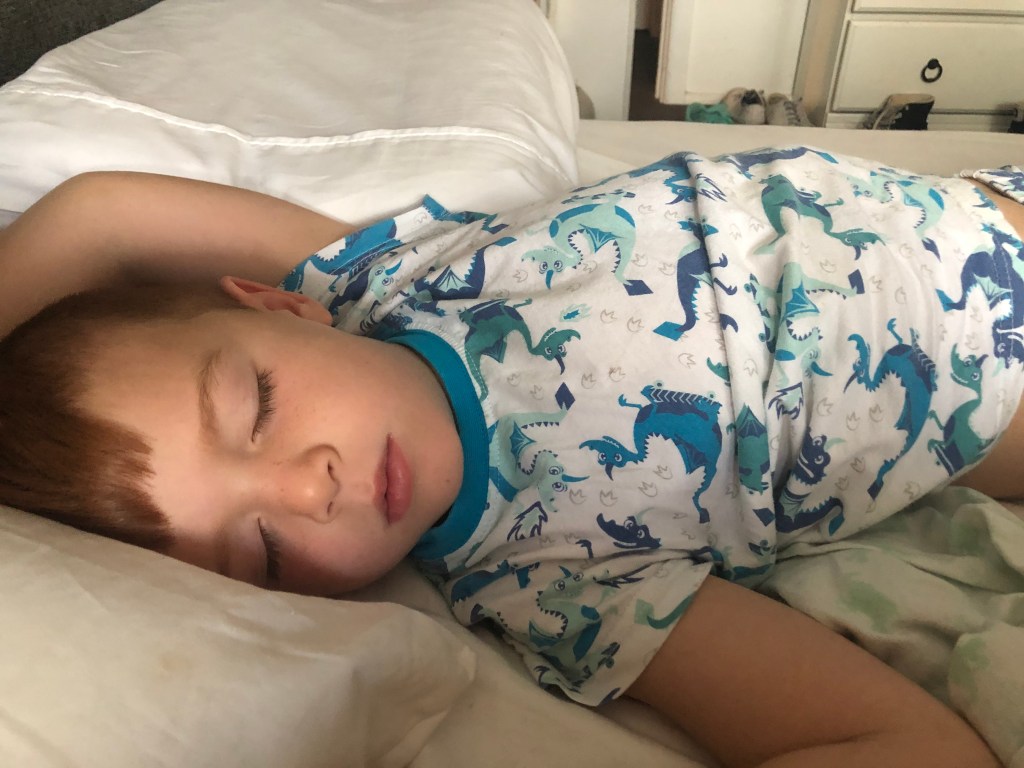
In the above paragraph I have tried to take an ordinary moment in my day and portray it in the stream of conscious style of writing of Virginia Woolf. I have tried to use her seamless shifting between 3rd person and 1st person to reveal inner thoughts as well as her unconventional punctuation to illustrate the battle between internal thoughts and external world intrusions on those thoughts. Her ability to discuss and pose larger concepts through every day events was one I really wanted to portray and hopefully have been able to express in the limited length of this blog post.
 Em's Literature Blog