Peer Review 1

Chikuru Malula

Critical- Write a short paragraph on why you think the Garma Festival is so important to indigenous culture today.

Thank you for such an informative blog posting Chikuru. I really enjoyed your systematic and objective style of writing. It was easy to read and makes the festival sound very exciting and well organised. You shared so many great details on the Garma festival. I would love to have heard about your personal take on the festival’s importance and possibly a linking of the festival to everyday aboriginal experiences, highlighting its cultural relevance. Thank you for the enjoyable read.

Link to original blog post by Chikuru : https://chikurumalula.home.blog/2019/08/14/garma-festival/

Peer Review 2

Reviewing: Jesse Owad

CRITICAL – What does A.D. Hope’s poem Australia (written half a century after the 1890s) add to the debate on what is Australia?

Jesse, this is a wonderful analysis of Hopes writing in general as well as his overall attitude and perspective in life. Having not read his works myself yet I was intrigued by your comments and motivated to look at his works. Having now read them I am even more convinced of the high quality of your critique. Your writing is easy to read while still being academic in nature. My only comment would be that your blog is almost double the recommended length, and while being wonderfully insightful was possibly a little lengthy for this assignment. Thank you for the very enjoyable read.

Link to original Blog by Jessie: https://102online.art.blog/2019/08/26/blog-2/

Dear Mr Cook

Creative: Write an imaginary conversation you are having either with one of the artists that you looked at yesterday or one of the characters that you saw in one of the paintings.

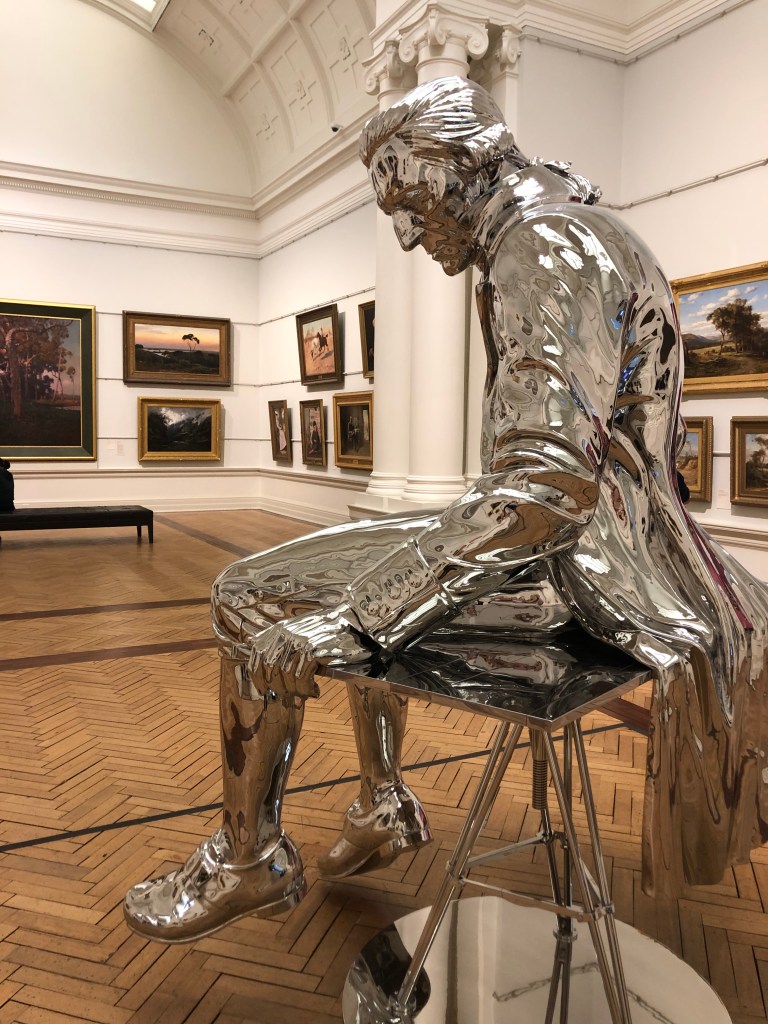
The English Channel-2015

Michael Parekowhai

Photo by Emily Baker 26.8.19

Dear Mr Cook,

I just have one question; are you proud?

Sitting here amongst these paintings, all inspired by a world you took so little time to understand, before you planted your flag and sailed on to your next conquest. Your usually triumphant look appearing crumpled despite your shiny exterior. Do you realise what you’ve done? Did you think about the consequence of your colonisation quest? Or was money and accolade all that lay before you?

Do you understand the destruction of both land and animal your discovery caused? Did you ever see its grace or beauty, this ancient raw land or was it just another uncultured place needing to be claimed and tamed? Did you not see they were one with it all? How could you have been so arrogant to think it was yours for the taking?

Did you see them there? Where was your respect for a people far more rich in culture, tradition, and spirituality than anything you had ever known? Oh all the things you could have learnt from them.

Was there no price to high for the expansion of your empire? The lives you’ve left murdered in cold blood; The babes ripped from mothers’ arms; The rape, abuse, torture and death you have left in your wake; the transgrenerational pain and displacement. Is this the legacy you intended?

Because from where Im standing, your slumped, defeated, shamed appearance seems rather fitting.

Yours Sincerely

A mother of children who are inheriting the mess you left behind

Patterson VS Lawson, and the Australian identity.

After reading these two authors this week I have spent a lot of time considering the links between their writing and the idea of the Australian experience and identity. With Patterson’s romanticised, rugged bush tales and the mythology he created against the doomsday, socialist, urban tales of woe, Lawson weaved.  Due to my limited word restrictions and the time frame I have decided to reflect on this simply in reference to my own personal experience.

Growing up you could say I had a Banjo Patterson upbringing, with a family that had for the majority been private school educated and upper middle class, country, caucasian background. We spent Christmas’s in Bowral at my grandmother’s house and school holidays in Cootamundra on my cousin’s big sheep farm. Lots of camping trips filled the years, with my father regularly taking us bush walking, canyoning and camping, all with a very Patterson romanticised iconic setting and perspective. He’d impart on us History and tales of Australian mythology and we would listen, in awe and soak it all up. Funnily enough, reflecting back as an adult, my dad was no farmer or swagman, I don’t even know if he could ride a horse! The world that he held in such esteem was not one he actually lived in, but like what he passed on to me, there was something in his childhood and identity that was tied to Patterson’s world.  

As I grew older, I was also private school educated, in an all girls school, one focused on service and community, social justice and an awareness of equity. Not continuing to go to the bush as much with bushwalks and camping now much more sporadic, it continues to be something I hold close and identify strongly with but there is a lot more of me that as an adult connects deeply with Lawson’s experiences and style of writing. The challenging of this capitalist and commercial life that we lead really resonates with me. I live in urban Sydney and I work very hard in two jobs and I often find myself searching and yearning for that country/bush connection that has been somewhat left behind in childhood. The occasional camping trip to a powered site in a caravan park on the south coast are the closest I get to it these days. There are now major parts of me that fight that suppression and government control that is very much inline with Lawson’s ideology. The socialist rebel that was born out of a liberal education, and a long hard 16 years struggling to understand my part and purpose in the ‘urban dream’, is one which I feel Lawson would feel proud of.  

Then there is possibly a final layer, I find myself not connecting with either in some way. Being female and feeling quite unrepresented in their works it leads me to question maybe these two identities are part of me but that none of us are these simplified identities so easily summed up in a few lines of a poem. Maybe we are pieces of everything stitched together in a makeup built on varying experience and tailored by life, changing with age and time. I can have my romantic attachment to the bush but at the same time I can be very grateful for that because of the comparison I now have with the city and our urban life. Maybe that bush identity and connection and appreciation for the environment is what makes the city life bearable, have meaning and depth. If I then add another layer on top of that of the feminist writings of Barbara Baynton and Mary Gilmore and you start to realise that identity, both Australian and individual identity, cannot be defined in one simple way of thinking nor summed up in a small collection of poems but more so, could be seen as a sort of anthology of works from multiple perspectives, all contributing in their own way to the complex texture of identity.  
Nostalgia’s Embrace

CREATIVE– Which poem or story that we have looked at so far made an impression on you? What was the impression it made?  Can you imitate the poem or story and create your own poem or story drawing on your own personal experience.

This week I have been quite intrigued by both the clear descriptive tone of Louisa Anne Meredith, as well as the gentle reflection and longing in Henry Kendall’s “Bell-birds”. With these in mind I have tried to recreate an experience that occurs for me annually when the first days of spring triggers memories of my youth. I have tried to use literary techniques we have looked at that I found new and challenging.

“Often I sit, looking back to a childhood
Mixt with the sights and the sounds of the wildwood”
Henry Kendall

And every year without fail the blessing of springs first rays hits my face
Igniting Her familiar warmth through my every cell.
Take me back, float me along, to the days of innocence, I beg Her.
Back to the days spent looking forward to now.
Flooding in they come; drowning five senses
The brush of the first gentle breaths of warm air on supple skin,
Scented with the sweet traces of springs’ petaled jewels, whose birth disturbs sharp buffalo lawns.
And youthful me trespassing to liberate them from their fate in the mowers’ path, selfishly drinking in their syrupy perfume.
Regal velvet petals bursting from the dry winter arms of magnolia trees, framing the path I traced homebound, dragging my feet not with the weight of depression but simply for the lack of urgency adolescences graciously allows.
Branched above, more a glint of light and a rustle of feathers than any solid form, rainbow friends offer shrill salutations,
Unburdened by the responsibilities of adult life with the only mark on any moment the eager anticipation of a tomorrow, filled with seemingly exciting grownup freedoms.
She is a clever illusionist, tugging me into reminiscence.
Memories of the cold long dark days of winter erased
Or maybe never stored to begin with
Only warm, only sun, only freedom, only promise.

Design a site like this with WordPress.com
Get started